FMCG Distribution Companies in UAE
The United Arab Emirates has developed into one of the Middle East’s most important markets for fast-moving consumer goods. Supported by modern ports, advanced logistics infrastructure, international trade connections, a diverse population, and a strong retail and hospitality sector, the country offers significant opportunities for manufacturers, importers, wholesalers, and FMCG distribution companies in UAE.
From food products, beverages, rice, spices, cooking ingredients, and household essentials to personal care products and other everyday consumer goods, FMCG products move through a highly competitive distribution network. For manufacturers and international brands entering the market, choosing the right FMCG distributor in UAE can play an important role in product availability, market penetration, customer development, and long-term growth.
What Is FMCG Distribution?
FMCG stands for Fast-Moving Consumer Goods. These are products that consumers purchase frequently and that generally move quickly through retail and wholesale channels. Food, beverages, packaged groceries, cooking ingredients, snacks, household products, personal care items, and cleaning products are common examples.
FMCG distribution connects manufacturers and importers with the businesses that ultimately sell or use these products. Depending on the product category, distributors may supply supermarkets, hypermarkets, grocery stores, wholesalers, restaurants, hotels, catering companies, cafeterias, food manufacturers, e-commerce businesses, and other commercial customers.
A professional FMCG distribution company does more than transport cartons from a warehouse to a customer. Effective distribution requires inventory planning, warehousing, sales management, route planning, customer relationships, merchandising, delivery coordination, market development, and continuous monitoring of product demand.
Why the UAE Is an Important FMCG Market
The UAE combines strong domestic consumption with international trade and re-export opportunities. Dubai in particular has established itself as an important regional food trading and logistics centre. Its ports, warehousing facilities, cold-chain capabilities, transportation networks, and access to international suppliers support the movement of food and consumer products across the market.
The scale of the opportunity is significant. According to Dubai International Chamber, retail sales of fresh and packaged food products in the UAE reached US$17.3 billion in 2025. This demonstrates the size and commercial importance of the country’s food and FMCG sector.
The UAE also serves as a strategic location for businesses seeking access to the wider GCC, Middle East, Africa, and Asian markets. As a result, FMCG companies operating in Dubai and other emirates may participate in local distribution as well as regional trading and re-export activities.
How FMCG Distribution Companies in UAE Support Brands
Successful distribution requires strong execution at every stage of the supply chain. An FMCG distributor may coordinate the movement of products from importation or local sourcing through warehousing and finally to wholesale, retail, foodservice, or industrial customers.
For international manufacturers, working with an experienced UAE distribution company can provide valuable local market knowledge. The distributor may understand purchasing patterns, customer expectations, competitive pricing, suitable sales channels, seasonal demand, and the operational requirements of serving different areas of the country.
Distribution companies can also help brands expand beyond a limited number of major accounts. A capable field sales operation can develop relationships with independent supermarkets, groceries, wholesalers, restaurants, catering companies, hotels, and other buyers that may otherwise be difficult for an overseas manufacturer to reach directly.
Major FMCG Distribution Channels in the UAE
The UAE FMCG market is not dependent on a single sales channel. Products can reach consumers and commercial users through several different routes, and the right strategy depends on the product, price positioning, packaging, target customer, and expected sales volume.
Supermarkets and Hypermarkets
Supermarkets and hypermarkets are highly visible FMCG sales channels in the UAE. They offer manufacturers access to large numbers of consumers and are particularly important for branded packaged food, beverages, cooking products, household goods, and personal care products.
Independent Groceries and Minimarts
Independent groceries and neighbourhood stores remain important for everyday consumer products. Their convenient locations and frequent customer traffic can make them valuable outlets for brands seeking broader market coverage.
Wholesale Markets and Traders
Wholesale distribution is particularly important for products sold in cartons, sacks, bulk packs, or larger commercial quantities. Wholesalers can help products move into smaller retail outlets, restaurants, catering businesses, and regional trading networks.
Hotels, Restaurants and Catering Companies
The HoReCa sector represents another important opportunity for FMCG and food distribution companies in UAE. Hotels, restaurants, cafeterias, cloud kitchens, catering businesses, and institutional kitchens require reliable supplies of ingredients and food products. Depending on the business, demand may include rice, spices, oils, seasonings, sauces, pulses, frozen foods, fresh produce, and other cooking ingredients.
Food Manufacturers and Industrial Buyers
Some food products are primarily intended for commercial processing rather than direct retail sale. Industrial customers may require larger packaging formats, consistent specifications, competitive pricing, reliable inventory, and scheduled deliveries. This creates opportunities for distributors capable of handling both retail and bulk food products.
E-Commerce and Online Grocery
Online shopping has become an additional route to market for FMCG brands. A distribution strategy that combines traditional wholesale, physical retail, foodservice, and digital channels can help manufacturers reach different customer groups without depending entirely on one segment.
FMCG Distribution in Dubai
Dubai is a particularly important location for FMCG trading and distribution because of its logistics infrastructure and international connectivity. Dubai Chambers has highlighted the emirate’s diversified food supply network, logistics links, warehousing capabilities, and cold-chain ecosystem as important factors supporting reliable food supply and trade.
Dubai Municipality also maintains food-related requirements and services covering areas such as food product registration and assessment, food activity permits, imported food consignments, food transportation, and other food safety matters. Companies importing and distributing food products therefore need to consider regulatory compliance alongside sales and logistics.
For businesses searching for FMCG distributors in Dubai, operational capability should be considered as carefully as sales promises. Warehouse capacity, delivery coverage, sales representatives, customer relationships, inventory management, and knowledge of applicable requirements can all influence the performance of a distribution partnership.
FMCG Distribution in Abu Dhabi and Other Emirates
Although Dubai is a major trading centre, an effective UAE distribution strategy should consider the wider national market. Abu Dhabi and Al Ain offer substantial opportunities across retail, hospitality, catering, institutional, and commercial channels. Sharjah and Ajman also have active wholesale and retail markets, while Ras Al Khaimah, Fujairah, and Umm Al Quwain can provide additional opportunities for brands seeking nationwide coverage.
A distributor with the ability to serve multiple emirates can help a brand build broader availability. However, nationwide expansion should be planned carefully. Delivery costs, customer density, order size, sales frequency, credit terms, and route efficiency all influence the profitability of distribution.
What to Look for in an FMCG Distribution Company in UAE
Choosing a distributor should not be based only on the lowest price or the largest customer list. Manufacturers should evaluate whether the distributor has genuine operational capacity and a strategy suitable for the product.
Market Coverage
A good distributor should clearly explain where it operates and which customer segments it serves. Some distributors are strongest in modern retail, while others specialise in wholesale, traditional trade, HoReCa, catering, or industrial customers.
Sales Team and Customer Development
Distribution requires active selling. Manufacturers should understand how many sales representatives will work on their products, which territories they cover, how frequently customers are visited, and how new accounts are developed.
Warehousing and Inventory Management
Reliable stock availability is essential in FMCG. Poor inventory planning can result in lost sales, expired products, excess stock, or inconsistent customer service. Distributors should therefore have appropriate warehousing and inventory-control processes for the categories they handle.
Delivery Capability
Fast and dependable delivery can become a competitive advantage, particularly for customers that order frequently. Vehicle capacity, delivery scheduling, route planning, order processing, and coverage should all be considered when evaluating an FMCG distribution partner.
Product and Regulatory Knowledge
Food distribution requires attention to applicable product registration, labelling, import, storage, transportation, and food safety requirements. Dubai Municipality provides dedicated services and guidance for food traders and establishments, including food product registration and assessment and the release of imported food consignments for the local market.
Transparent Commercial Terms
Manufacturers and distributors should clearly agree on pricing, margins, payment terms, promotional spending, returns, damaged goods, expiry management, sales targets, geographic coverage, and responsibilities for marketing. Clear commercial arrangements can reduce misunderstandings as the business grows.
Challenges in FMCG Distribution
The UAE offers strong opportunities, but FMCG distribution remains highly competitive. Distributors need to manage changing freight costs, inventory levels, customer credit, promotional pressure, product shelf life, delivery expenses, and competition from established brands.
Another challenge is balancing sales growth with profitability. High sales volume does not automatically produce a healthy distribution business. Companies need to understand the complete landed cost of products as well as warehousing, transportation, sales commissions, salaries, promotions, damaged stock, returns, and customer credit exposure.
For new brands, market awareness can also take time to develop. Competitive pricing may help generate initial interest, but sustainable growth normally requires a combination of product quality, reliable supply, effective marketing, active sales coverage, and strong customer service.
Opportunities for International FMCG Manufacturers
The UAE can provide an attractive entry point for manufacturers seeking to develop business in the Gulf region. Its international trading environment and established logistics ecosystem allow suppliers from Asia, Europe, Africa, and other regions to connect with importers, distributors, wholesalers, retailers, and foodservice buyers.
Manufacturers entering the UAE should first identify the most suitable customer segment for their product. A retail product may require consumer branding, convenient packaging, merchandising, and promotional support. A foodservice or industrial product may depend more heavily on price consistency, bulk packaging, technical specifications, and reliable supply.
Instead of trying to enter every channel immediately, manufacturers can often benefit from establishing a focused distribution strategy, measuring customer response, improving product positioning, and then expanding geographically or into additional channels.
The Importance of Reliable Supply in FMCG
Availability is one of the foundations of successful FMCG distribution. Customers need confidence that products can be supplied consistently. Frequent stock shortages can encourage retailers and commercial buyers to switch to competing brands.
This is particularly important for frequently used food ingredients and everyday consumer products. Distributors should monitor sales velocity, maintain appropriate safety stock, plan replenishment cycles, and communicate with suppliers well before inventory reaches critical levels.
Reliable supply also strengthens relationships with wholesalers, supermarkets, restaurants, and catering companies. When customers know that a distributor can provide consistent stock, competitive pricing, and dependable delivery, repeat business becomes easier to develop.
Why Local Market Knowledge Matters
The UAE is a diverse market, and customer demand can differ significantly by location and sales channel. Products that perform strongly in one area may require different packaging, pricing, promotion, or sales approaches in another.
Local market knowledge helps distributors understand which customers to target, what pack sizes are suitable, how competing products are positioned, and which areas offer the greatest potential. This information can also help manufacturers adapt their market-entry strategy instead of relying entirely on approaches used in other countries.
Building a Successful FMCG Distribution Strategy in UAE
A successful strategy begins with a clear understanding of the target market. Businesses should identify their priority customer groups, competitive price range, distribution territories, expected monthly volume, required inventory, and marketing budget before committing significant resources.
Sales performance should then be measured consistently. Useful indicators include active customers, new accounts opened, average order value, repeat-order rate, gross margin, sales by territory, sales by representative, stock turnover, delivery cost, and overdue receivables.
As distribution expands, businesses can use this information to allocate resources toward the products, customers, and territories generating the strongest sustainable returns.
Meridian PF General Trading and FMCG Distribution in UAE
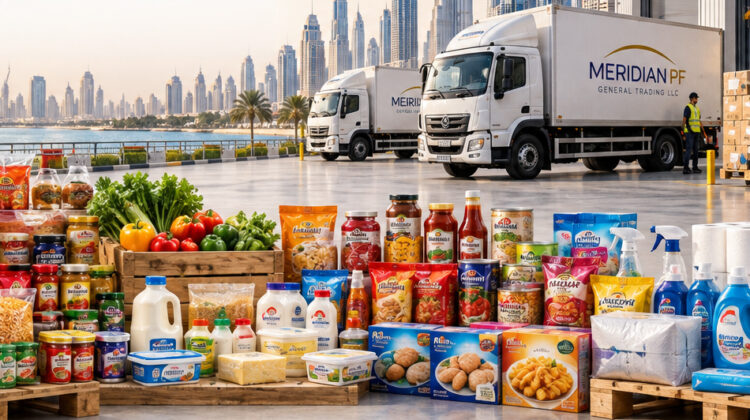
Meridian PF General Trading L.L.C operates in the UAE FMCG trading and distribution sector, serving business customers across relevant wholesale, retail, foodservice, and commercial channels. The company’s focus is on developing dependable product availability, competitive commercial relationships, and practical distribution solutions for the UAE market.
For manufacturers and brands seeking FMCG distribution in UAE, the objective should extend beyond simply placing products in a warehouse. Successful market development requires sales activity, customer acquisition, reliable delivery, inventory planning, and long-term relationships with buyers.
Meridian PF General Trading works to connect products with suitable market channels while supporting the requirements of wholesalers, supermarkets, restaurants, catering businesses, retailers, and other commercial customers.
How Manufacturers Can Choose the Right UAE Distributor
Before appointing an FMCG distributor, manufacturers should discuss expected sales volumes, target customers, territory coverage, marketing responsibilities, inventory commitments, payment arrangements, and performance expectations. Both parties should understand how success will be measured.
It is also useful to review the distributor’s experience with comparable product categories. A company experienced in foodservice distribution may offer different strengths from a distributor focused primarily on supermarkets. The best partner is therefore not necessarily the largest distributor, but the company whose capabilities match the brand’s target market and growth strategy.
Future of FMCG Distribution in the UAE
The UAE’s position as an international trade and logistics hub continues to create opportunities for FMCG businesses. Growth in food retail, hospitality, e-commerce, regional trade, and diversified sourcing is encouraging distributors to strengthen their logistics, inventory systems, customer coverage, and digital capabilities.
At the same time, competition means distributors and brands must become more efficient. Businesses that combine reliable supply, strong sales execution, market intelligence, regulatory awareness, competitive pricing, and responsive customer service will be better positioned to build sustainable market share.
Conclusion
FMCG distribution companies in UAE play an essential role in connecting manufacturers and importers with the country’s supermarkets, groceries, wholesalers, restaurants, catering companies, hotels, food businesses, and other commercial customers.
For brands planning to enter or expand in the UAE, selecting an experienced distribution partner can help improve market access, product availability, customer development, and operational efficiency. The most successful partnerships are built around clear objectives, transparent commercial terms, reliable inventory, active sales coverage, and a shared commitment to long-term growth.
Meridian PF General Trading L.L.C aims to support manufacturers, suppliers, wholesalers, retailers, restaurants, catering companies, and other business customers looking for reliable FMCG trading and distribution solutions in the UAE. By combining market knowledge with a practical approach to sales and distribution, the company is positioned to support brands seeking sustainable growth in one of the region’s most dynamic consumer markets.
Frequently Asked Questions About FMCG Distribution Companies in UAE
What does an FMCG distribution company do?
An FMCG distribution company connects manufacturers or importers with retail, wholesale, foodservice, and commercial customers. Its activities may include warehousing, inventory management, sales, order processing, transportation, merchandising, and customer development.
How do I find an FMCG distributor in Dubai?
When searching for an FMCG distributor in Dubai, evaluate the company’s product experience, sales coverage, warehouse facilities, delivery network, customer base, payment terms, and ability to serve your target market. Manufacturers should also discuss expected volumes and marketing responsibilities before appointing a distributor.
Which products are commonly handled by FMCG distributors?
FMCG distributors may handle rice, spices, seasonings, cooking oils, pulses, snacks, beverages, canned products, confectionery, dairy products, frozen foods, household goods, personal care products, and many other frequently purchased consumer products.
Can UAE FMCG distributors supply restaurants and catering companies?
Yes. Many food distributors serve the HoReCa sector, including restaurants, hotels, cafeterias, catering companies, commercial kitchens, and other foodservice customers. Product formats and commercial terms may differ from those used for supermarket and retail distribution.
Can international manufacturers appoint a distributor in the UAE?
International manufacturers can work with UAE importers and distribution companies to develop local sales, subject to the applicable commercial, product registration, import, labelling, and regulatory requirements. Manufacturers should select partners according to their product category, target channels, required geographic coverage, and commercial objectives.
Why is Dubai important for FMCG distribution?
Dubai offers international connectivity, modern logistics infrastructure, warehousing capabilities, access to major ports, a diverse consumer market, and established wholesale and retail networks. These advantages have helped make Dubai an important centre for food and FMCG trade in the UAE and the wider region.